


Standard ISO Flat Rack Container
The 20’ Flat Rack Container (ISO 22P1) is designed for transporting oversized, heavy and out-of-gauge cargo that cannot be loaded into a standard shipping container. Built in accordance with ISO and CSC requirements, it features a reinforced loading platform with two fixed end walls and no side walls or roof. The ISO code 22P1 identifies a 20-foot Flat Rack Container with fixed ends.
Its open design allows loading from the top, side or end using cranes, forklifts or other heavy lifting equipment while remaining fully compatible with international intermodal transport by sea, rail and road.
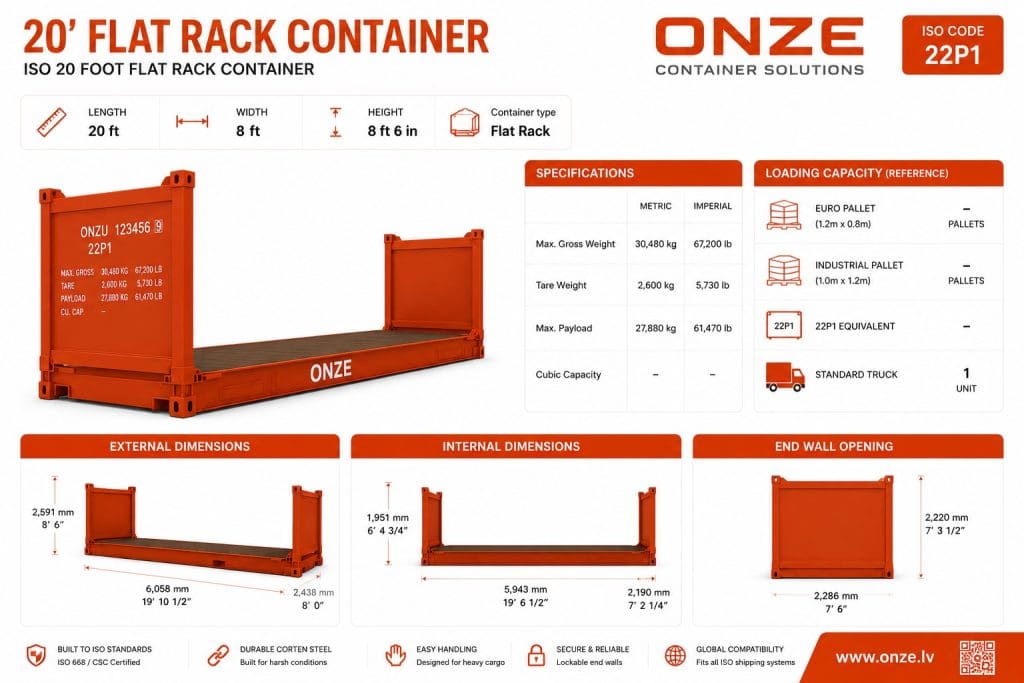
Technical Specifications
| pecification | Value |
|---|---|
| ISO Code | 22P1 |
| External Length | 6,058 mm |
| External Width | 2,438 mm |
| External Height | 2,591 mm |
| Platform Length | 5,638 mm |
| Platform Width | 2,230 mm |
| End Wall Height | 2,233 mm |
| Maximum Gross Weight | 31,000 kg |
| Tare Weight | 2,750 kg |
| Maximum Payload | 28,250 kg |
External Dimensions
The external dimensions comply with ISO standards, ensuring compatibility with container vessels, trucks, railway wagons and lifting equipment worldwide.
- Length: 6,058 mm
- Width: 2,438 mm
- Height: 2,591 mm
The reinforced base provides excellent support for concentrated and oversized loads.
Platform Dimensions
Unlike a standard container, the Flat Rack uses an open loading platform instead of enclosed cargo space.
- Platform Length: 5,638 mm
- Platform Width: 2,230 mm
- End Wall Height: 2,233 mm
The absence of side walls allows cargo to extend beyond the container width when permitted by transport regulations.
Loading Access
The open construction enables loading from multiple directions.
Cargo can be loaded:
- From the top using cranes
- From both sides
- Through the end
- Using forklifts where applicable
This flexibility makes Flat Rack containers ideal for heavy and oversized cargo.
Payload & Weight Ratings
The reinforced steel frame provides excellent strength for transporting concentrated loads.
- Maximum Gross Weight: 31,000 kg
- Tare Weight: 2,750 kg
- Maximum Payload: 28,250 kg
Actual payload depends on manufacturer specifications and cargo weight distribution.
Cargo Types
Typical cargo includes:
- Industrial machinery
- Construction equipment
- Generators
- Steel structures
- Pipes
- Wind turbine components
- Boats
- Vehicles
- Large tanks
- Heavy project cargo
Cargo may exceed the standard container width or height, provided transport regulations are observed.
Flat Rack Design
The 22P1 Flat Rack Container features:
- Two fixed steel end walls
- No side walls
- No roof
- Reinforced steel base
- Multiple lashing points
- Heavy-duty flooring
- ISO corner castings
- Crane lifting compatibility
The fixed end walls provide additional support for securing cargo during transport.
Construction
The structure is manufactured from high-strength Corten steel, providing excellent durability under demanding operating conditions.
Standard construction features include:
- Reinforced steel platform
- Fixed end walls
- Heavy-duty flooring
- Multiple lashing rings
- CSC certification
- ISO corner castings
- Forklift handling compatibility
Applications
The 20’ Flat Rack Container is commonly used for:
- Heavy machinery
- Construction equipment
- Industrial equipment
- Steel products
- Pipes
- Boats
- Vehicles
- Generators
- Mining equipment
- Project cargo
Standards & Certification
This container type complies with internationally recognised transport standards, including:
- ISO 668
- ISO 6346
- CSC Convention
- International intermodal transport requirements
These standards ensure worldwide compatibility with ports, depots, shipping lines and logistics operators.
Frequently Asked Questions
What does ISO code 22P1 mean?
22P1 identifies a standard 20-foot Flat Rack Container with fixed end walls.
What is the difference between a Flat Rack and an Open Top container?
A Flat Rack has no roof and no side walls, while an Open Top container retains side walls and only the roof is removable.
What cargo is transported on a Flat Rack?
Typical cargo includes oversized machinery, steel structures, vehicles, generators, boats and heavy industrial equipment.
What is the maximum payload?
The maximum payload depends on the container manufacturer and model. Always refer to the CSC plate before loading.
Is the container suitable for international shipping?
Yes. It is designed specifically for international intermodal transport by sea, rail and road.