


Standard ISO Tank Container
The 20’ Tank Container (ISO 22T6) is designed for the safe transportation of hazardous liquids in bulk. Manufactured in accordance with ISO and CSC requirements, it consists of a stainless-steel pressure vessel mounted within a reinforced ISO frame, ensuring full compatibility with international intermodal transport by sea, rail and road.
The ISO code 22T6 identifies a 20-foot tank container designed for dangerous liquids with a minimum test pressure of 6.0 bar.
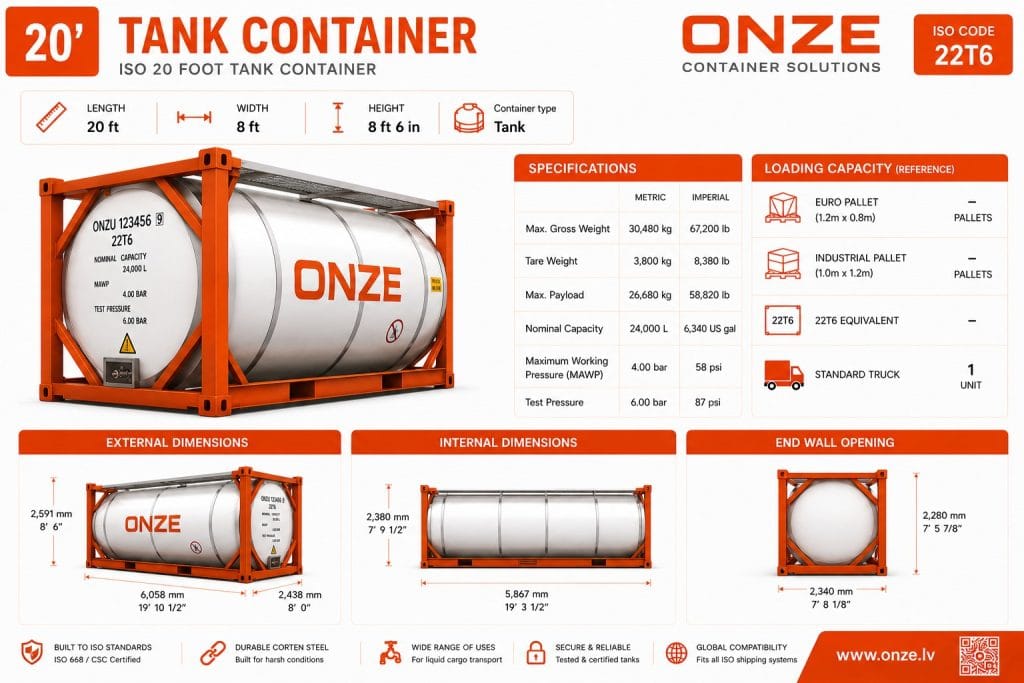
Technical Specifications
| Specification | Value |
|---|---|
| ISO Code | 22T6 |
| External Length | 6,058 mm |
| External Width | 2,438 mm |
| External Height | 2,591 mm |
| Tank Capacity | 21,000–26,000 litres* |
| Maximum Gross Weight | 36,000 kg* |
| Tare Weight | 3,600–4,000 kg* |
| Maximum Payload | Up to 32,000 kg* |
| Minimum Test Pressure | 6.0 bar |
*Actual specifications depend on the tank manufacturer and configuration.
External Dimensions
The external dimensions comply with ISO standards, allowing unrestricted use throughout international container transport systems.
- Length: 6,058 mm
- Width: 2,438 mm
- Height: 2,591 mm
The ISO frame enables handling with standard container cranes, reach stackers, trucks and railway wagons.
Tank Capacity
The stainless-steel pressure vessel is designed for transporting bulk liquids safely and efficiently.
Typical capacity:
- 21,000–26,000 litres
The exact capacity depends on shell thickness, insulation, heating system and product requirements.
Loading & Discharge
The tank is equipped with dedicated loading and discharge equipment for efficient handling of liquid cargo.
Typical equipment includes:
- Top loading manlid
- Bottom outlet valve
- Pressure relief devices
- Vapour return connection
- Emergency shut-off systems
Configuration may vary depending on the cargo carried.
Payload & Weight Ratings
The reinforced ISO frame provides excellent structural strength while maintaining a high payload.
Typical ratings:
- Maximum Gross Weight: 36,000 kg
- Tare Weight: 3,600–4,000 kg
- Maximum Payload: Up to 32,000 kg
Actual values depend on the manufacturer and tank specification.
Tank Design
The 22T6 Tank Container consists of:
- Stainless steel pressure vessel
- Reinforced ISO frame
- Top loading manlid
- Bottom discharge valve
- Pressure relief system
- Steam heating compatibility (optional)
- Thermal insulation (optional)
- Walkway and safety handrails
The T6 designation specifies the pressure class used for transporting hazardous liquid cargo.
Construction
The container is manufactured using:
- Stainless steel tank shell
- Carbon steel ISO frame
- CSC certification
- ISO corner castings
- Heavy-duty support saddles
- Corrosion-resistant construction
This design ensures long service life in demanding chemical and food-grade logistics operations.
Applications
The 20’ Tank Container is commonly used for transporting:
- Chemicals
- Hazardous liquids
- Solvents
- Acids
- Industrial liquids
- Petroleum products
- Liquid fertilizers
- Food-grade liquids (where applicable)
- Oils
- Alcohols
The suitability depends on the tank specification and product compatibility.
Standards & Certification
This container type complies with internationally recognised transport standards, including:
- ISO 668
- ISO 6346
- CSC Convention
- IMDG Code
- ADR/RID (where applicable)
These standards ensure worldwide compatibility with ports, depots, shipping lines and logistics operators.
Frequently Asked Questions
What does ISO code 22T6 mean?
22T6 identifies a 20-foot ISO Tank Container designed for transporting dangerous liquids with a minimum test pressure of 6.0 bar.
What products can be transported?
Typical cargo includes chemicals, industrial liquids, hazardous substances, petroleum products and selected food-grade liquids when the tank specification allows.
What is the tank capacity?
Most 20-foot tank containers have a capacity between 21,000 and 26,000 litres, depending on the manufacturer and tank configuration.
Can the tank be heated?
Many tank containers can be equipped with steam heating, electric heating or insulation depending on the cargo requirements.
Is the container suitable for international shipping?
Yes. It is specifically designed for international intermodal transport by sea, rail and road.