


Complete Guide to ISO Shipping Containers
Shipping containers are available in a wide range of ISO-standard designs to meet different transport and storage requirements. While the standard dry container remains the most commonly used solution, specialized container types have been developed for temperature-controlled cargo, oversized machinery, bulk materials, liquids and palletized freight.
This guide provides an overview of the most common ISO shipping container types together with their technical specifications, dimensions and typical applications.
Whether you are transporting general cargo, refrigerated products, project cargo or hazardous liquids, selecting the correct container type improves loading efficiency, cargo safety and transportation costs.
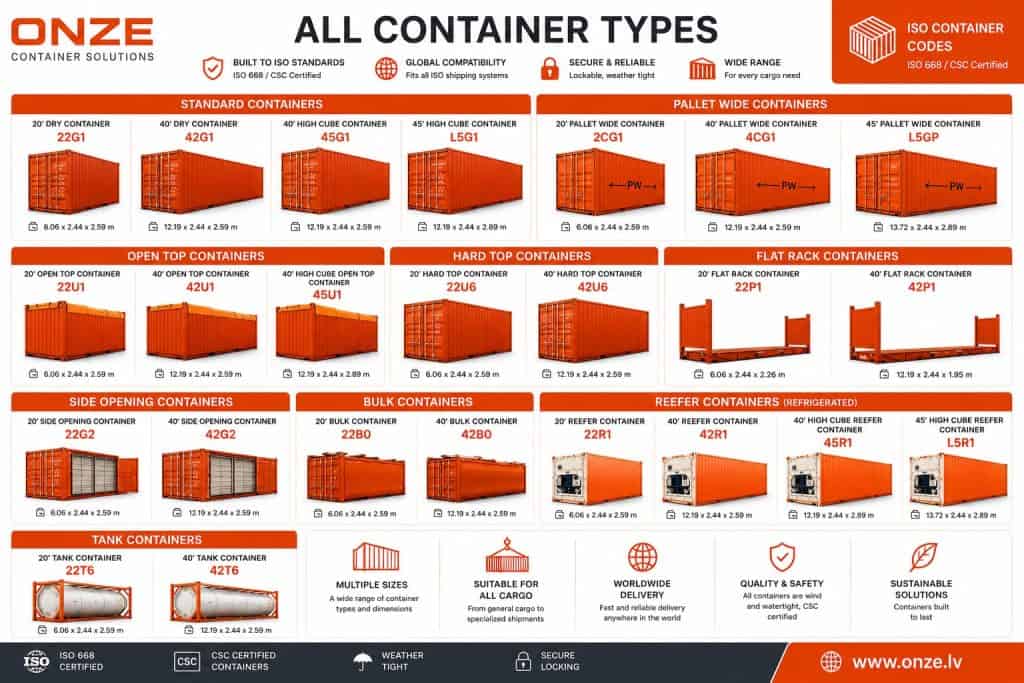
Standard Dry Containers
General purpose containers are the most widely used ISO containers for transporting dry cargo.
- 20’ Dry Container (22G1)
- 40’ Dry Container (42G1)
- 40’ High Cube Container (45G1)
- 45’ High Cube Container (L5G1)
These containers are suitable for palletised goods, cartons, machinery, consumer products, industrial cargo and general freight.
Refrigerated Containers (Reefer)
Reefer containers maintain controlled temperatures throughout transport and are used for temperature-sensitive cargo.
- 20’ Reefer Container (22R1)
- 40’ Reefer Container (42R1)
- 40’ High Cube Reefer Container (45R1)
- 45’ High Cube Reefer Container (L5R1)
Typical cargo includes:
- Frozen food
- Meat
- Seafood
- Fruit
- Vegetables
- Dairy products
- Pharmaceuticals
- Flowers
Open Top Containers
Open Top containers feature a removable roof, allowing cargo to be loaded from above using cranes.
Ideal for:
- Machinery
- Steel structures
- Pipes
- Timber
- Over-height cargo
Hard Top Containers
Hard Top containers offer the flexibility of top loading while providing the protection of a removable steel roof.
These containers are commonly used for heavy industrial cargo requiring crane loading.
Flat Rack Containers
Flat Rack containers have no side walls or roof, allowing transportation of oversized and out-of-gauge cargo.
Typical applications include:
- Construction equipment
- Industrial machinery
- Wind turbine components
- Boats
- Steel structures
Tank Containers
Tank containers are designed for transporting liquids, chemicals and food-grade products in bulk.
Typical cargo includes:
- Chemicals
- Liquid fertilizers
- Oils
- Alcohols
- Food-grade liquids
Bulk Containers
Bulk containers are specifically designed for transporting dry bulk commodities without bags or pallets.
Typical cargo includes:
- Grain
- Coffee beans
- Cocoa
- Animal feed
- Plastic granules
- Fertilizers
Side Opening Containers
Side Opening containers provide full-length side access in addition to standard rear cargo doors.
They are particularly suitable for:
- Long cargo
- Timber
- Pipes
- Machinery
- Palletised freight
Pallet Wide Containers
Pallet Wide containers provide increased internal width, allowing more Euro pallets to be loaded compared with standard ISO containers.
These containers are widely used in European distribution networks where pallet optimization is essential.
How to Choose the Right Shipping Container
The best container depends on the type of cargo being transported.
| Cargo Type | Recommended Container |
|---|---|
| General cargo | Dry Container |
| High-volume cargo | High Cube Container |
| Temperature-controlled goods | Reefer Container |
| Heavy machinery | Flat Rack Container |
| Over-height cargo | Open Top Container |
| Bulk solids | Bulk Container |
| Liquids | Tank Container |
| Long cargo | Side Opening Container |
| Euro pallet transport | Pallet Wide Container |
Each container type has been engineered to meet specific logistics requirements while remaining compatible with global shipping infrastructure.
Frequently Asked Questions
What is the most common shipping container?
The 20’ Dry Container (22G1) and 40’ Dry Container (42G1) are the most widely used containers worldwide.
What is a High Cube container?
A High Cube container provides approximately 30 cm of additional internal height compared with a standard container, increasing cargo volume.
Which container is best for refrigerated cargo?
Temperature-sensitive products should be transported in Reefer containers equipped with integrated refrigeration units.
What is the difference between an Open Top and a Flat Rack container?
An Open Top container has side walls and a removable roof, while a Flat Rack has no roof and no side walls, making it suitable for oversized cargo.
Which container is best for Euro pallets?
Pallet Wide containers maximize pallet capacity by providing additional internal width, allowing two Euro pallets to fit side by side with minimal unused space.