


Standard ISO High Cube Container
The 40’ High Cube Container (ISO 45G1) is a standard general purpose shipping container designed for transporting and storing dry cargo throughout the global intermodal transport network. Manufactured in accordance with ISO and CSC requirements, it provides additional internal height compared with a standard 40-foot container while maintaining full compatibility with container ships, rail transport and road haulage.
The increased internal volume makes the 40’ High Cube Container particularly suitable for lightweight, high-volume cargo requiring additional loading space.
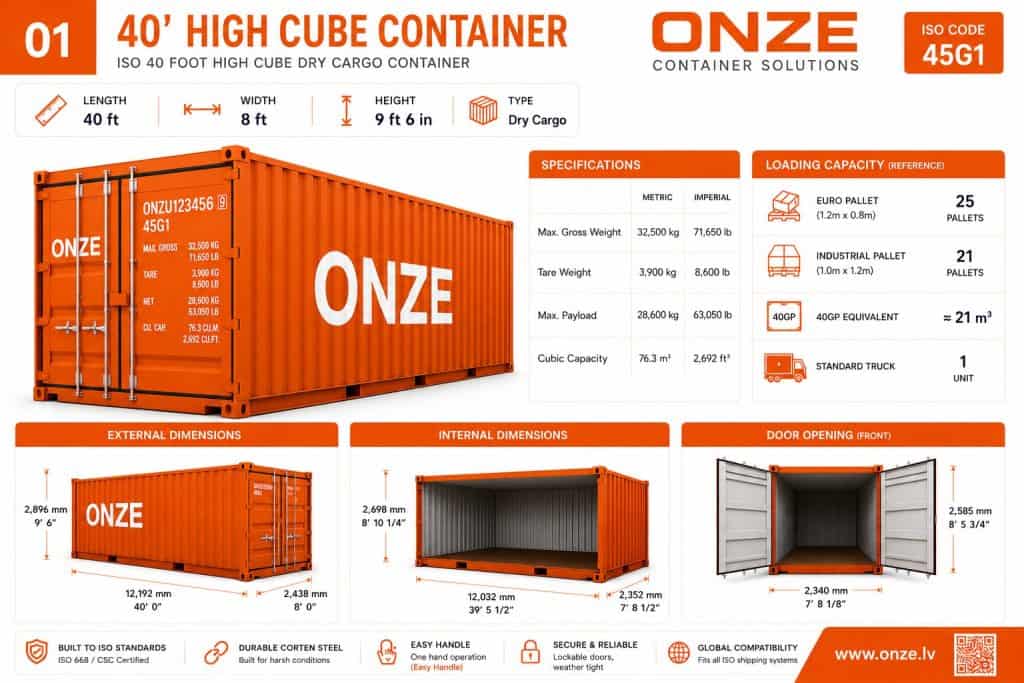
Technical Specifications
| Specification | Value |
|---|---|
| ISO Code | 45G1 |
| External Length | 12,192 mm |
| External Width | 2,438 mm |
| External Height | 2,896 mm |
| Internal Length | 12,032 mm |
| Internal Width | 2,352 mm |
| Internal Height | 2,698 mm |
| Door Opening Width | 2,340 mm |
| Door Opening Height | 2,585 mm |
| Maximum Gross Weight | 32,500 kg |
| Tare Weight | 3,900 kg |
| Maximum Payload | 28,600 kg |
| Cubic Capacity | 76.3 m³ |
External Dimensions
The external dimensions comply with ISO standards, allowing unrestricted use across international container transport systems.
- Length: 12,192 mm
- Width: 2,438 mm
- Height: 2,896 mm
The standardized footprint enables efficient handling by container cranes, reach stackers, trucks and railway wagons.
Internal Dimensions
The internal cargo space has been designed to maximize usable loading volume while maintaining structural strength.
- Length: 12,032 mm
- Width: 2,352 mm
- Height: 2,698 mm
With a capacity of 76.3 m³, the container accommodates a broad range of palletised, packaged and loose cargo.
Door Opening
Full-width double cargo doors allow safe and efficient loading using forklifts, pallet trucks and other warehouse equipment.
Door opening dimensions:
- Width: 2,340 mm
- Height: 2,585 mm
These dimensions simplify loading operations while providing sufficient clearance for standard cargo units.
Payload & Weight Ratings
The container combines a relatively low tare weight with a high permissible payload.
- Maximum Gross Weight: 32,500 kg
- Tare Weight: 3,900 kg
- Maximum Payload: 28,600 kg
This makes the unit particularly suitable for transporting high-volume freight while maintaining excellent structural integrity.
Loading Capacity
Typical loading configurations include:
- 25 Euro pallets (1200 × 800 mm)
- 21 Industrial pallets (1200 × 1000 mm)
- 76.3 cubic metres of cargo volume
Actual loading capacity depends on cargo dimensions, packaging and weight distribution.
Construction
The structure is manufactured from high-strength Corten steel, providing excellent durability under demanding operating conditions.
Standard construction features include:
- ISO corner castings
- Double cargo doors
- Marine plywood floor
- Weather-resistant door seals
- Forklift handling compatibility
- CSC certification
- Locking gear designed for international shipping
Applications
The 40’ High Cube Container is commonly used for:
- International shipping
- Import and export cargo
- Domestic transportation
- Warehouse storage
- Distribution logistics
- Manufacturing
- Retail supply chains
- Consumer goods
- Industrial products
- Furniture
- Packaging materials
- General freight
Standards & Certification
This container type complies with internationally recognised transport standards, including:
- ISO 668
- ISO 6346
- CSC Convention
- International intermodal transport requirements
These standards ensure worldwide compatibility with ports, depots, shipping lines and logistics operators.
Frequently Asked Questions
What does ISO code 45G1 mean?
45G1 identifies a standard 40-foot High Cube General Purpose Container manufactured in accordance with ISO specifications.
How much cargo fits inside?
The internal volume is 76.3 cubic metres.
How many pallets can be loaded?
The container accommodates approximately 25 Euro pallets or 21 Industrial pallets.
What is the maximum payload?
The maximum payload is 28,600 kg.
Is the container suitable for sea freight?
Yes. It is designed specifically for international intermodal transport by sea, rail and road.